
How to Travel to India for Treatment from Somalia
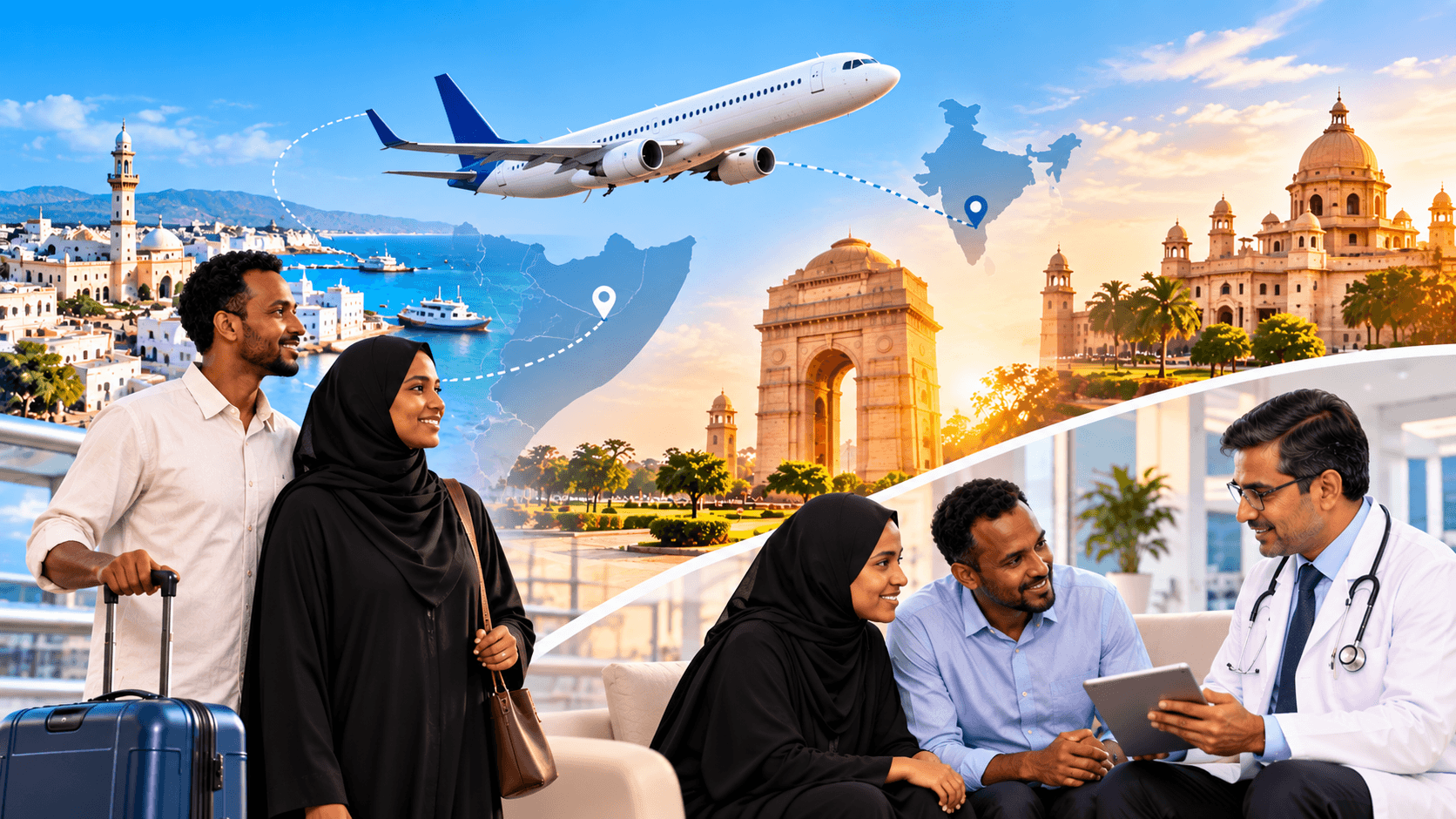
Medical tourism from Somalia to India involves more than arranging a flight or facility. Patients and their families must schedule medical consultations, choose a hospital, get cost estimates, arrange visa documents, find local lodging, then fly to India for medical treatment. A medical tourism facilitator India can support patients throughout their journey and achieve their goals.
Start With Your Medical Records in Somalia
Before traveling, one should first collect the necessary medical information. Patients must assemble recent medical reports, diagnostic images, lab findings, prescriptions, prior treatment history and information about currently taken medicines.
If you have already seen a doctor in Somalia, be sure to attach the respective referral and prescriptions for treatment. All records will assist an Indian doctor in reviewing your medical history before you get there.
Your facilitator can assist with the compilation of these data as well as with their transmission to the corresponding hospitals and specialists in India. This will enable patients to receive an opinion before arriving.
Be careful not to book a non refundable flight until you are sure that there is a doctor and a hospital able to deal with your treatment.
Choose the Right Hospital and Specialist
India has many doctors and hospitals specializing in different areas of medicine, such as cardiac care, oncology, orthopedics, neurosurgery, fertility treatment, organ transplantation and more. Nevertheless, the exact hospital choice depends on the specific medical diagnosis and treatment needed by the patient.
The hospital should be selected by taking into account a number of factors such as the relevant department, availability of specialists, hospital credentials, diagnostic facilities, availability of service for foreign patients and type of needed treatment.
The organization providing assistance can contact the medical institutions and doctors according to the documents provided by the patient. The attending doctor and hospital will make all the decisions regarding the case and medical treatment.
Patients are advised to ask questions regarding the prescribed treatment, duration of hospitalization, period of recovery, tests to be done and lot of other things before boarding the plane.
Request a Treatment Plan and Cost Estimate
Once the hospital reviews the patient’s medical information, it may provide a preliminary treatment plan and estimated cost. This gives the patient a better understanding of what to expect before traveling.
The estimate may include hospital charges, doctor’s fees, diagnostic tests, medicines, room charges and other expected expenses depending on the treatment.
However, patients should understand that an initial estimate is not always the final cost. After an in person consultation or additional testing, doctors may identify medical requirements that were not visible in the initial records.
Ask the hospital or facilitator about what the estimate includes and which expenses may be separate. This can help the family prepare a realistic budget for treatment, travel, accommodation, food, transportation and other personal expenses.
Understand the Medical Visa Requirements
Patients traveling to India for medical treatment need to understand the appropriate visa requirements before making their travel plans. India provides medical visa options for eligible international patients, including an e Medical Visa route for qualifying travelers.
A valid passport, evidence of health issues, and a letter or document from a legitimate Indian hospital are all usually required for obtaining a visa. Family members who accompany the patient might be required to hold a medical attendant visa or any other travel clearance.
Visa requirements and documents can change at any time, so it is best to check the Government of India website on obtaining a visa before applying.
A facilitator can help coordinate hospital documentation and explain which documents may be needed during the process. However, the visa decision is made by the relevant Indian authorities, not by the facilitator.
Plan Your Flight and Accommodation
After treatment arrangements and travel documentation are in place, the next step is planning the journey from Somalia to India.
Patients should consider the location of the hospital when selecting flights and accommodation. Staying at a convenient location can make transportation easier, particularly when several hospital visits are expected.
Before departure, arrange:
- Flight bookings
- Airport pickup
- Accommodation
- Transportation to the hospital
- Transportation for accompanying family members
- Emergency contact information
- Copies of medical and travel documents
International patients may benefit from keeping digital copies of their passport, visa, medical reports, prescriptions, hospital documents and travel details.
Coordinating these arrangements before departure can reduce unnecessary stress after arriving in India.
What Happens After You Arrive in India?
This way of client journey could be described as the very first step that starts from the airport. From the airport, it could be arranged to take the client straight to the hotel or to the accommodation (depending on the current affairs).
The following step might be a consultation with the treating specialist. The doctor might evaluate earlier health care information, perform a physical assessment and suggest further evaluation.
The testimony can be valuable because at this point, the doctor is ready to proceed with this plan, and the testimony can be used.
After completing the treatment plan, the hospital will be able to start the procedures outlined in the medical opinion. Your facilitator will be able to help you with any consultations or appointments, hospital logistics, travel or daily life during your stay.
Controlling medical decisions is the responsibility of the treating doctors and the hospital.
Support During Treatment
International patients may face problems not normally experienced by local patients, for example language barrier, travel issues, unfamiliar environment and communication problems with the hospitals.
In addition, a facilitator may be able to help with elements of the treatment process, such as; arranging for an interpreter, helping to make appointments or help with communication.
If the patient is traveling with family, there can be problems with accommodation and also travelling arrangements.
In the case of emergency situations, having a single contact person can assist with communication between family and hospital staff.
Prepare for Your Return to Somalia
The process of planning the return journey is just as important when it comes to medical tourism. Patients who are about to leave India must ensure that they get their discharge summary, medical reports, doctors’ suggestions, prescription, test reports and whatever advice the healthcare provider gives regarding the treatment.
Inquire with the physician regarding follow up meetings, medicines to be taken, do’s and don’ts and complications that need to be looked into. As necessary, the doctor also assesses whether the traveler is fit enough to travel according to his condition.
Normally, the Indian hospital staff keeps track of the follow up recommendations that can be implemented by the doctor in the patients’ home country.
A Simple Checklist for Somali Patients
Before traveling to India for treatment, make sure you have:
- A valid passport
- Appropriate Indian visa
- Recent medical reports
- Diagnostic scans and test results
- Prescriptions and medication information
- Hospital confirmation or appointment details
- Flight information
- Accommodation arrangements
- Airport transportation
- Emergency contact details
- Travel and insurance documents where applicable
- Copies of important documents
Preparing these items in advance can make the journey more organized and help avoid unnecessary delays.
Conclusion
Traveling to India from Somalia is an undertaking that calls for proper planning at every step of the way. The journey starts with the process of making medical records and finding a suitable hospital specialist. The next steps include hospital checks, treatment plans, financial planning and visa processing.
With the help of a facilitator, the practical side of this trip can be managed, while the medical side will remain in the hands of the hospital and doctors involved in the process. The patient and his family should organize everything upfront and will be able to process any medical travel related issues in a smooth way.
When you decide to get treatment in India, start collecting your medical records and history to give hospitals insight into your case and make it easier to plan the entire process.
About the Author: Priya Sharma